
Connect it once. Stop being the localization bottleneck.
Every translation cycle ends up on your desk: exporting the strings, re-importing whatever comes back, resolving what the round-trip mangled, and doing it again next release.
The tooling assumes a human will paste files between systems, so the integration is a script nobody owns, formats lose their structure on the way through, and translation is coupled to production rather than to the branch that actually needs it.
How TextSetu handles it
Someone asks you to wire up localization. Again.
- 01
API, CLI and webhooks
Full REST API and CLI, with webhooks for run completion and approval events, so localization fits into CI rather than beside it.
- 02
Repo connected once
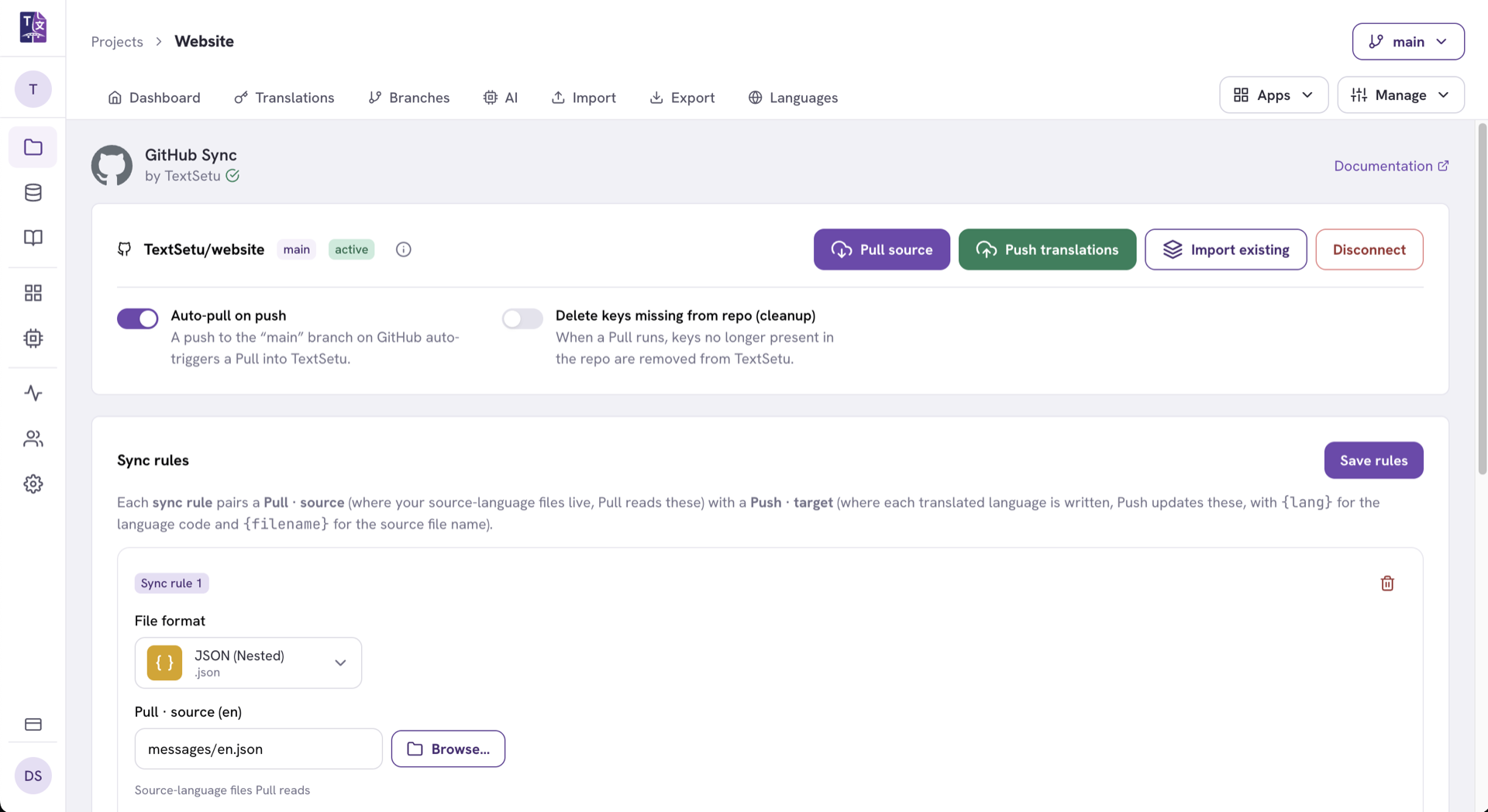
Connect the repo once and sync source strings automatically. Step one of the workflow disappears permanently.
- 03
Branch-aware runs
Branch-aware runs: point a translation at a feature branch, review the diff, merge when the copy is ready, and leave protected production alone.
- 04
20+ formats, round-tripped
Round-trip fidelity across 20+ formats: .xcstrings, ARB, i18next, RESX, Qt .ts, XLIFF, Android XML and the rest come back with structure, keys and ordering intact.
- 05
Five prompt layers, in precedence
The engine composes five layers in strict precedence: models, brand voice, per-language instructions, glossary and memory, then an optional reviewer model, and only the terms matching the source string are injected, so prompts stay tight.
Localization becomes a pipeline step with an API, not a recurring interrupt.
Localization becomes a pipeline step with an API, not a recurring interrupt.